
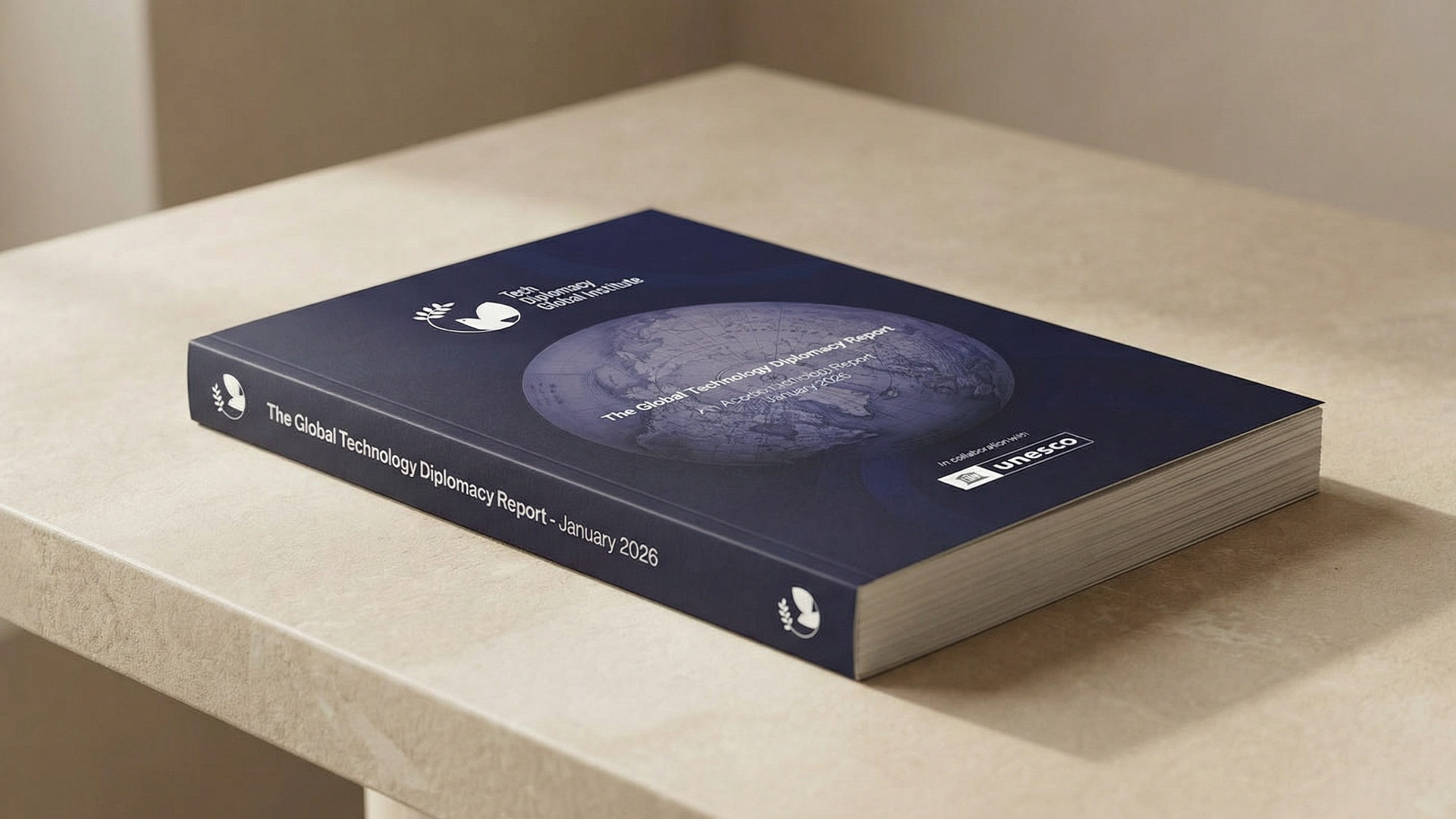
The Tech Diplomacy Global Institute has released its first flagship publication, The Global Technology Diplomacy Report 2026, marking an important milestone in the institutionalization of technology diplomacy at the global level. Authored by Ayumi Moore Aoki, with contributing authors Sarah Al Feghali and Ambassador Eugenio Garcia, the report provides a structured, comparative analysis of how countries and regions are embedding technology diplomacy into their foreign policy and governance architectures.
A New Reference for Tech Diplomacy
The Global Technology Diplomacy Report 2026 examines how technology diplomacy is evolving from scattered, experimental initiatives into formal structures, mandates, and roles within more than twenty national and regional contexts. It offers both a reference and a call to action for governments, international organizations, industry, and civil society seeking to navigate an increasingly complex digital landscape.
The report situates tech diplomacy as a distinct discipline at the intersection of international relations and technology governance, going beyond digital diplomacy and science diplomacy by focusing explicitly on AI, data, cybersecurity, and emerging technologies as core subjects of negotiation and cooperation. It highlights the institutional models, governance frameworks, and diplomatic functions that are beginning to define this new field.
Why This Report, and Why Now
Today’s digital economy is valued at approximately 24 trillion, yet global governance remains fragmented and uneven. More than 140 data protection laws, over 60 AI frameworks, and at least 40 national cryptocurrency regulatory schemes operate simultaneously, creating complexity, compliance burdens, and systemic risk.
At the same time, more than 170 countries still lack formal tech diplomacy representation, resulting in what the report describes as a “tech diplomacy gap” with significant implications for innovation, inclusion, and strategic autonomy. The report argues that closing this gap is now a strategic necessity for national governments and multilateral institutions alike.
From Early Movers to Global Momentum
Drawing on comparative case studies, the report documents how a number of early movers have begun to formalize tech diplomacy mandates through tech ambassadors, specialized offices, inter-ministerial coordination mechanisms, and multistakeholder platforms. It shows how these countries and regions are gaining influence in shaping international norms, standards, and cooperation mechanisms by treating tech diplomacy as a core diplomatic function rather than an ad hoc extension of existing portfolios.
The report also examines the role of multilateral organizations, regional bodies, and emerging networks in building more coherent and inclusive technology governance ecosystems. It underscores the importance of combining institutional innovation with capacity-building, particularly for developing countries, to avoid deepening existing asymmetries.
Strategic Pathways and Recommendations
The Global Technology Diplomacy Report 2026 sets out a series of strategic pathways to strengthen tech diplomacy and global technology governance. Among its key messages is the need to:
- Institutionalize dedicated tech diplomacy functions within foreign ministries and related institutions.
- Develop hybrid expertise that bridges diplomatic, regulatory, and technical domains.
- Implement adaptive, modular governance frameworks capable of evolving with rapid technological change.
- Address capacity disparities through targeted support, shared resources, and inclusive participation models.
- Reinforce coordination among multilateral institutions and regional initiatives to reduce fragmentation and forum shopping.
These recommendations are presented not as abstract principles, but as actionable directions informed by current practice and emerging innovations across multiple jurisdictions.
About the Author and the Institute
The report is authored by Ayumi Moore Aoki, Founder and President of the Tech Diplomacy Global Institute, with contributing authors Sarah Al Feghali and Eugenio Garcia. In parallel with this work, Ayumi is a Doctoral Candidate at École des Ponts Business School, pursuing research on Tech Diplomacy Institutional Design, a qualitative multiple case study examining how different countries structure and implement their approaches to technology diplomacy.
The Tech Diplomacy Global Institute, serves as a permanent platform dedicated to advancing coordinated, inclusive, and future-ready governance of transformative technologies. Through research, convening, and capacity-building, the Institute works to ensure that technological progress strengthens multilateral cooperation rather than deepening fragmentation.
Access the Report
The Global Technology Diplomacy Report 2026 is available as an open-access publication and is intended as a shared resource for policymakers, diplomats, industry leaders, researchers, and civil society actors engaged in shaping the governance of emerging technologies.
👉 Download the Global Technology Diplomacy Report 2026:
https://tdgi.org/the-global-technology-diplomacy-report-2026/